

Hi there,
Most practices are not short of data. The difficulty is that it rarely reaches the person making a decision in a form they can use, at the moment they need it. That is the thread through this week's issue, first in a white paper we have published with Epic Games and then in my conversation with Angelos Chronis about climate simulation that now runs in seconds inside the design tools architects already use.
The detail from the paper that I keep coming back to is from Argonne National Laboratory, where much of the work on a live digital twin went into turning more than 5,000 model elements into 220 sensor-linked zones, each checked against engineering drawings, before any sensor data could be placed in the right location. Geometry travels well from one tool to the next, but its meaning has to be rebuilt.
Below you will find the paper, the interview, two new tools in the database, three events on 15 October (I am speaking at one of them), a short research survey and a computational design role at BeeGraphy.
Let's get into it. 👇
What Sparked the Most Discussion This Week
From Data to Decisions: our new white paper with Epic Games
The AEC industry does not have a data availability problem. It has a data usability problem. BIM models with millions of elements, simulation outputs, live sensor feeds and now AI recommendations each sit in their own tool, and very few of the people who need to act on them can see how they fit together.

From Data to Decisions, written in partnership with Epic Games, looks at how teams are using Unreal Engine to close that gap, and follows three organisations doing it in practice. Implexus Lab built a live digital twin of a liquid-metal test loop at Argonne National Laboratory, showing more than a thousand sensors in spatial context. Jacobs uses its RealScene platform to train first responders in scenarios that are too rare or too dangerous to rehearse for real. Buro Happold turns masterplans into interactive environments where planners, engineers and clients can see how a district will perform before it is built.
The paper is free to download, and everyone who downloads it will hear about the upcoming webinar first.
One question I would like your answer to: which of the three would make the biggest difference on your projects, and why? Reply to this email and tell me.
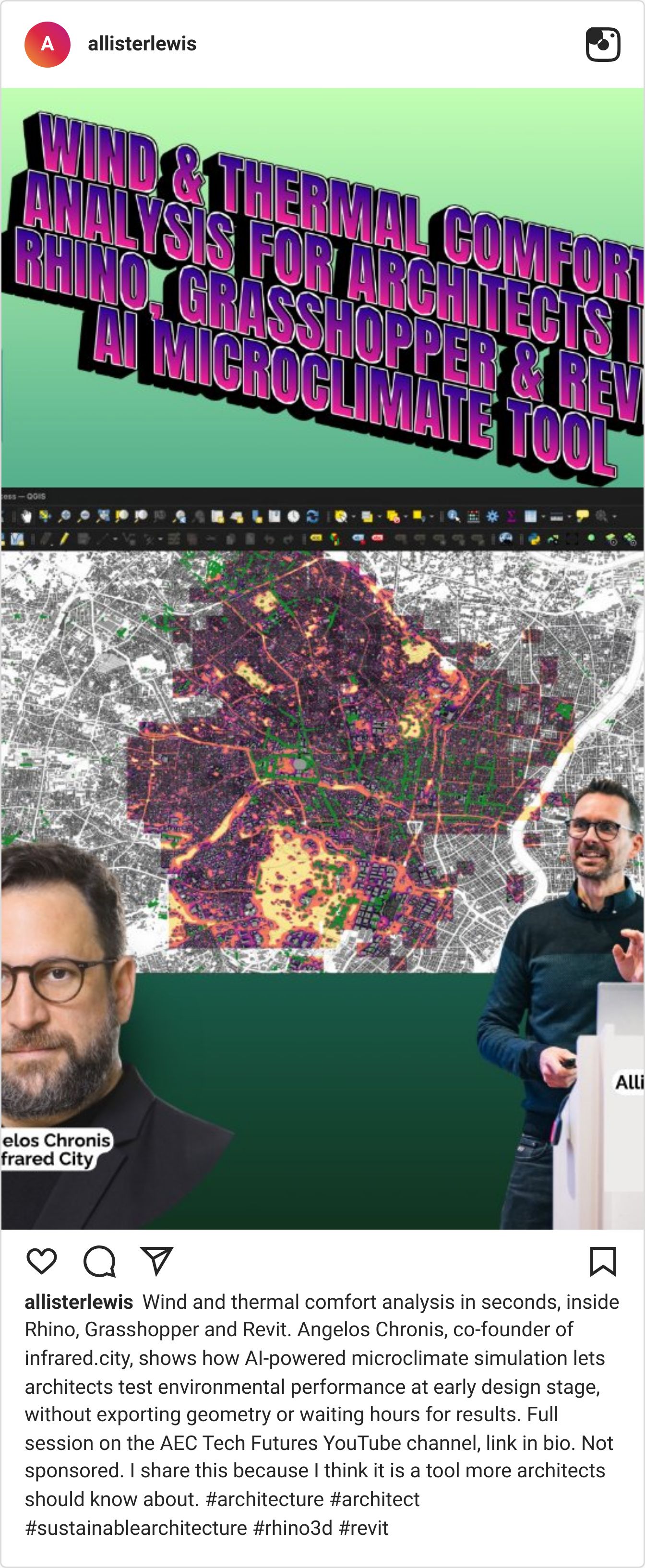
Sustainability simulation used to take hours but now runs in seconds, and it plugs straight into Grasshopper and Revit. I asked the founder how that changes the way architects design.
The ADDD Workshop: a practical starting point for AI and technology decisions
The Workshop is a focused half-day session, held in person or online with your team, that looks at where technology and AI can help your practice and where they are currently causing friction. We begin by talking through how your team actually works, from early design through to delivery, so that the conversation is grounded in your real workflows rather than in a generic view of what a practice should be doing. From there we go through practical examples of tools that are relevant to your discipline, which gives everyone a shared and realistic picture of what is available and what is worth paying attention to.
I have been running workshops for Orms, Haworth Tompkins, Levitt Bernstein, DMWR, EPR and Morris & Co.

Within the session we identify the main problems holding the practice back, agree on which opportunities are worth pursuing first, and talk openly about the cost of leaving things as they are. Within a few days you receive a written report that sets out the key findings, the priorities and the recommended next steps, so the discussion turns into something you can act on and share with the wider team or the partners.
The Workshop is intended to give you strategic clarity, and it is not a technical audit of your systems. It works well as a first step for practices that know their tools and processes need attention but are not yet sure where to begin, and it can lead on to deeper work such as a early stage workflow software, Technology Blueprint or ongoing advisory support if that turns out to be useful.
Book a call here: 30 min with Allister Lewis
News & Events
CityShift 2026 - Vilnius
Thursday 15 October at Tech Zity Vilnius, Lithuania; CityShift is a one-day conference on real estate, construction, technology and cities, bringing together developers, investors, city leaders, founders and architects from across Europe, with speakers this year including Theo Blackwell, Chief Digital Officer at the Greater London Authority, and Dominik Campanella of Concular.
I am speaking, so if you are going, come and find me!


Women in BIM Conference London 2026
Thursday 15 October at Regent Street Cinema, 307 Regent Street, London W1B 2HW. This year's theme is AI in Action, with a programme built around moving AI out of pilots and into everyday, repeatable practice, and a networking evening and drinks reception the night before. Details and tickets

DTUG x Forma Futures Challenge
Thursday 15 October, 2.30pm to 7.30pm, hosted by Hawkins\Brown at 30 Clerkenwell Road, London EC1M 5PG. The Design Technology User Group and Autodesk are running a hands-on afternoon: an update on Forma Site Design and Forma Building Design from the team building them, an hour of guided training with no Forma experience needed, then a two-hour sprint on one of the four Forma Futures Challenge briefs on adaptive housing for 2035, finishing with pitches, feedback from the judges and a people's-choice award. DTUG x Forma Futures Challenge Tickets, Thursday, October 15 • 2:30 PM - 7:30 PM | Eventbrite

A ten-minute research request!
A PhD researcher at UNSW is studying how design firms capture and reuse project knowledge, and has asked whether ADDDitive readers would complete a ten-minute survey. All responses are anonymised, so no individual or firm is identified in the findings. If you leave your email at the end, you will receive the finished report on current knowledge capture practice across AEC firms, covering benchmarks, the common gaps and what the top-performing firms are doing differently. The more practices that take part, the more useful those benchmarks will be.
Take the survey: How design firms capture and reuse project knowledge
New this week: 5 New software in the ADDD Database
Each week I share new software added to the ADDD Database, plus specific categories, to help you find the right solutions and stay up to date on what's emerging.
Foveate - a presentation workspace for architects and designers that turns drawings, renders, video and 3D models into one interactive link. AI helps you assemble it faster, and you can see who opened it and what held their attention. Free to sign up. foveate.com

Revalu - Kasper by revalu is the AI-powered materials advisor for the built environment, delivering project-specific insights across cost, carbon, and performance in minutes. Forward

Civly - Upload a sketch or CAD file. Draftmate, the Civly agent, drafts the floors, structure, MEP and code checks directly in Revit, so your studio designs instead of drafting. Draftmate by Civly: AI drafting for architects, in Revit

Nodu - Nodu turns construction models into a live, financial-aware systems instead of static drawings. Nodu

viabim - Via BIM Tools is a bundle of 17 Revit add-ins - battle-tested on data center projects spanning 40+ linked models and hundreds of megawatts of infrastructure. Via BIM Tools - Revit Add-ins for Large, Complex Projects | 17 Tools, One Bundle

Videos Update
One Role Worth Noticing This Week
BeeGraphy is looking for someone to design and build features for its online computational design program, working closely with its design team so the tools fit real workflows and stay intuitive. The listing asks for a strong grounding in computational and parametric design alongside React, Node.js and TypeScript, familiarity with modern web application architecture and databases, and comfort with testing, code review and version control. It is worth noticing because it shows where parametric design skills are heading, which is into the browser, and it is a realistic next step for anyone who has outgrown Grasshopper scripts and wants to build the tools rather than use them.
→ View role: Here
See all roles here: www.aectechjobs.com/search

What this issue means for you
Everything in this issue comes back to the same point, which is that the value of project information depends on who can use it and when. At Argonne, the geometry moved across without much trouble but the model only became useful once someone had rebuilt what each part of it meant, zone by zone, and checked it against the drawings.
With infrared.city, the analysis itself is not new but moving it from a specialist check at the end of a stage into the design tool while the massing is still changing alters which decisions it can influence. Two new tools make the same move on a smaller scale, with Foveate putting drawings, renders and models in front of a client in one place, and Kasper putting cost and carbon information in front of the person choosing the material. In each case the gain comes from shortening the distance between the information and the decision, rather than from producing more information.
The practical step is to pick one recurring decision on a live project, such as a façade material, a massing change or a wind comfort question on a public space, and trace it back. Write down where the information behind that decision comes from, how long it takes to arrive, what has to be converted or re-entered along the way, and who actually sees it before the decision is made. Wherever meaning is being rebuilt by hand, or the answer arrives after the design has moved on, that is where a tool or a workflow change will pay back first, and where it is worth testing against the software you already pay for before buying anything new. If you would rather work through that with someone in the room, that is what the half-day workshop below is for.
Get in touch - reply to this email or book a call: 30 min with Allister Lewis
That's it for this week.
If something in here landed - or if you disagree - reply and tell me. I read every response.
Thanks for reading!
Allister

Richard is dreaming of data food.
