

Connect, collaborate, and be inspired by a day of industry insights, innovations, and the latest Naviate developments.


Hi there,
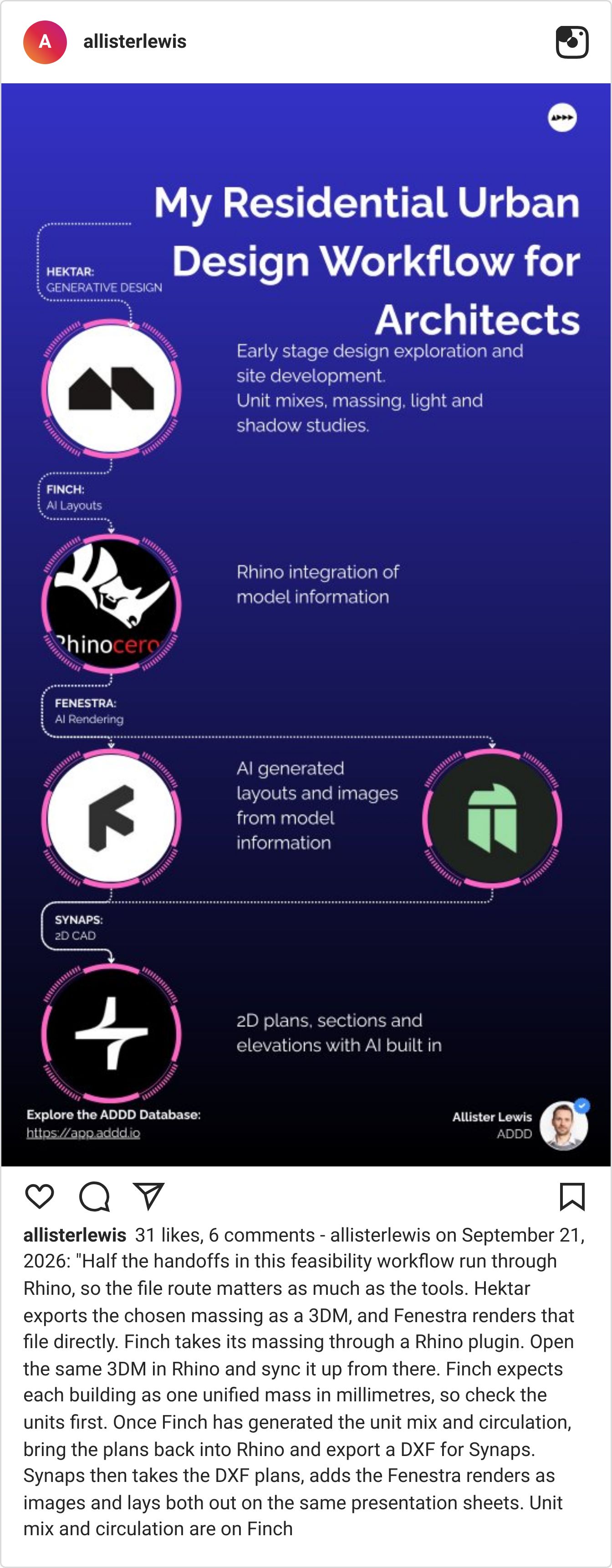
All three of my posts this week were about the same part of a project, the first few weeks of feasibility and early-stage design. The first argued that Revit is the wrong tool for that stage, even though most practices open it there anyway. The second looked at why most feasibility studies stop at three options, which has more to do with what the fee will pay for than with design judgement. The third answered an architect who told me my early-stage tool stack is a waste of money. He is half right because a collection of tools with no data path between them was never the answer.
Taken together, the three posts describe one problem. In most practices, the number of options a client sees at feasibility is set by whichever software happens to be open and by the hours the fee allows, rather than by a decision anyone has actually made.
Below: the three posts, five new tools in the ADDD Database, three London events in October, a short research survey on how practices capture project knowledge, and a sales role at Archistar that shows the same shift happening on the planning side.
Let's get into it. 👇
This week's partner: Symetri
Symetri builds Naviate, a suite of add-ins for Revit, Civil 3D, Autodesk Construction Cloud and Forma that concentrates on BIM standards, project health and data management. This issue argues that Revit should not be the first tool you open on a project, and the other half of that argument is that once you do open it, the quality of the data going into the model decides how useful it is for everything that follows. Symetri's Naviate User Group is in London on Thursday 1 October, with a full day on BIM and data management, AI in practice and the Naviate roadmap, and I am speaking in the 11:15 session on tools for better data management.
Save your seat: The Design Automation Forum | Symetri.co.uk
Partner slots are paid and labelled, and they never influence what I write or recommend.
What Sparked the Most Discussion This Week
An architect told me my early stage tool stack is a waste of money. He is half right.

Nobody tests forty massing options in Revit because the fee will not stretch that far. So most feasibility studies stop at three options, and the client picks the best of a very small sample.

Revit is not an early-stage design tool. Most practices use it as one anyway.

MY ADDD WORKSHOP: Find out what standing still is costing you
Most practices don't need a full technology review. They need an honest answer to one question: what is our current setup actually costing us in time and money? That is what the ADDD workshop is for. It is a half-day session with your team where we look at how you use technology today, where the hours go missing, and which of those problems are worth fixing first. You get a written report on where the issues are, existing workflow review, tech stack, challenges and opportunities, technology vision and what standing still is costing you.
I have been running workshops for Orms, Haworth Tompkins, Levitt Bernstein, DMWR, EPR and Morris & Co.

If you run or work in a practice of between 30 and 200 people and you suspect your tools are costing more than they should, book a 30-minute call. I will tell you honestly whether a workshop is the right place to start, or whether it isn't yet.
Book a call here: 30 min with Allister Lewis
News & Events
Women in BIM Conference London 2026
Thursday 15 October at Regent Street Cinema, 307 Regent Street, London W1B 2HW. This year's theme is AI in Action, with a programme built around moving AI out of pilots and into everyday, repeatable practice, and a networking evening and drinks reception the night before. Details and tickets

DTUG x Forma Futures Challenge
Thursday 15 October, 2.30pm to 7.30pm, hosted by Hawkins\Brown at 30 Clerkenwell Road, London EC1M 5PG. The Design Technology User Group and Autodesk are running a hands-on afternoon: an update on Forma Site Design and Forma Building Design from the team building them, an hour of guided training with no Forma experience needed, then a two-hour sprint on one of the four Forma Futures Challenge briefs on adaptive housing for 2035, finishing with pitches, feedback from the judges and a people's-choice award. DTUG x Forma Futures Challenge Tickets, Thursday, October 15 • 2:30 PM - 7:30 PM | Eventbrite

A ten-minute research request!
A PhD researcher at UNSW is studying how design firms capture and reuse project knowledge, and has asked whether ADDDitive readers would complete a ten-minute survey. All responses are anonymised, so no individual or firm is identified in the findings. If you leave your email at the end, you will receive the finished report on current knowledge capture practice across AEC firms, covering benchmarks, the common gaps and what the top-performing firms are doing differently. The more practices that take part, the more useful those benchmarks will be.
Take the survey: How design firms capture and reuse project knowledge
New this week: 5 New software in the ADDD Database
Each week I share new software added to the ADDD Database, plus specific categories, to help you find the right solutions and stay up to date on what's emerging.
Matera - Matera is a material intelligence platform for building-product manufacturers. It gives teams visibility into their specification pipeline, identifies where revenue may be at risk, and surfaces actionable intelligence to help protect design intent and convert more specifications into orders. Matera is currently working with select manufacturers through private Design Partner pilots. Home | Matera

Forward Plan - Forward is a design management platform that centralizes project information and collaboration for the construction industry, structured around the RIBA Plan of Work. It streamlines document and drawing management, revision control, and approval workflows while providing clients with clear visibility into project progress. The platform eliminates administrative overhead by automating information sharing across architects, consultants, contractors, and clients. Forward

Flexy - Flexy is an AI design studio that converts natural language prompts into editable Rhino geometry, parametric scripts, and design iterations. It provides integrated tools for text-to-image generation, urban master planning with AI zoning and road layouts, and design research collaboration. The platform supports multiple LLM providers and enables architects and designers to rapidly prototype concepts from ideation through detailed design. https://flexy.design/

Ploterr - "The tools that draw our world have barely moved in thirty years. We are rebuilding them on OpenGeometry, open at the core, for people and agents to design together. We are in stealth right now, with a release planned this fall." https://ploterr.com

Stacked - Stacked is an AI copilot designed for structural engineers that converts marked-up PDFs into fully parameterized 3D structural models. It provides both conceptual design capabilities using an in-house solver and detailed design workflows that integrate with industry-standard FEM software, while automatically handling code compliance and report generation. Stacked · Structural Engineering Copilot

Videos Update
The Knowledge Cliff: Why Architecture Firms Are Losing Expertise - and How to Fix It
One Role Worth Noticing This Week
“The role is remote, based in Ontario or British Columbia, with customer and industry travel. Archistar is hiring a senior individual contributor to win new municipal customers across Canada for its AI PreCheck product, which helps municipalities assess planning and building requirements earlier and improve the quality of applications before they enter the permitting process. The listing asks for seven or more years in enterprise SaaS or technology sales, a track record of selling into Canadian municipalities and a working knowledge of RFPs and public-sector procurement, and the package is salary and commission, with equity available for the right candidate. It is worth noticing alongside this week's posts, because it is the same move towards checking a scheme earlier, happening on the planning side of the counter rather than in the practice.”
→ View role: Here
See all roles here: www.aectechjobs.com/search

What this issue means for you
The same pattern runs through all three posts. At feasibility, the decisions that shape everything afterwards are being made by default rather than on purpose. Revit gets opened early because one integrated model seemed sensible, and from then on the software sets the pace and forces decisions before anyone is ready to make them. The fee sets the number of options, which is how most studies stop at three. The objections to working differently are fair but when I took them one at a time, none of them had actually been tested, and cost was rarely the real one.
What is usually missing is not the tools but someone putting them together and testing them against the software the practice already pays for, which is why the Rhino point in the second post matters more than any single tool in it.
The practical step is small. Take one recent feasibility study and write down how many options were actually tested, what each one was tested against, whether that was the site, the brief, the numbers, daylight or compliance, and which piece of software each step ran in. If the answer is three options and a Revit model opened in the second week, that is the gap. Then choose one early-stage workflow and test it against the stack you already run, paying most attention to the connections between the tools and the hand-off into Revit or Archicad, because that is where the integration problem shows up. Do it in a controlled environment with a person checking the output, rather than unsupervised on a live project. If you would rather work through it with someone in the room, that is what the half-day workshop below is for.
Get in touch - reply to this email or book a call: 30 min with Allister Lewis
That's it for this week.
If something in here landed - or if you disagree - reply and tell me. I read every response.
Thanks for reading!
Allister

Richard is looking forward to autumn - warm afternoons indoors..
