

Hi there,
Three things this week, and they all point in the same direction. I went back through two years of a WhatsApp group with 450 architects, engineers and AI developers in it, and the clearest finding was that the engineering effort has moved off the model and onto everything built around it. In the same week, half of LinkedIn was posting Astra demos while almost none of that work was happening inside a real studio. And in Chicago I spent a few days working out what ADDD is actually for, and arrived at the same answer from a different direction. The model is not the product. The workflow around it is.
Below: the five findings from the group, why Tim Fu's agentic Rhino pipeline is the one worth watching rather than the demo reels, a five-tool early-stage design stack running at £149 a user a month, and a product role at Higharc.
Let's get into it. 👇
xFigura
xFigura does AI Rendering for Architects incredibly well. This is running in a practices such as KPF, BIG, OMA, H&deM, Snohetta, and the thing worth knowing is it gives you great control over the workflow of image and video generation. If you are exploring AI rendering and want a mature tool, it is worth a look. ADDDitive readers get 15% discount through this link:https://x-figura.link/allister-lewis use code ALLISTER15OFF.
Partner slots are paid and labelled, and they never influence what I write or recommend.

What Sparked the Most Discussion This Week
7,000 WhatsApp messages. 450+ architects, engineers and AI developers. Two years talking about nothing but AI in AEC. It's a more honest record of where this industry actually is than any keynote.

Everyone's been posting Astra demos this week. None of it is happening inside a real studio yet.

Last week I went to Chicago to meet three people I had only met on LinkedIn. I went with a plan. I came back with a different one.

MY ADDD WORKSHOP: Find out what standing still is costing you
Most practices don't need a full technology review. They need an honest answer to one question: what is our current setup actually costing us in time and money? That is what the ADDD workshop is for. It is a half-day session with your team where we look at how you use technology today, where the hours go missing, and which of those problems are worth fixing first. You get a written report on where the issues are, existing workflow review, tech stack, challenges and opportunities, technology vision and what standing still is costing you.
I have been running workshops for Orms, Haworth Tompkins, Levitt Bernstein, DMWR, EPR and Morris & Co.

If you run or work in a practice of between 30 and 200 people and you suspect your tools are costing more than they should, book a 30-minute call. I will tell you honestly whether a workshop is the right place to start, or whether it isn't yet.
Book a call here: 30 min with Allister Lewis
News & Events
I'm joining Symetri at their Naviate User Group Event - a day of industry peers, Naviate experts and guest speakers focused on the challenges shaping today's construction and design industry, including project management, BIM systems, data handling and AI in construction workflows.
When: 1 October 2026, 9:00am - 4:45pm
Where: Derbyshire House, St Chad's Street, London, WC1H 8AG
Sign up here: Naviate User Group Event | Symetri.co.uk

New this week: Top workflow of the week
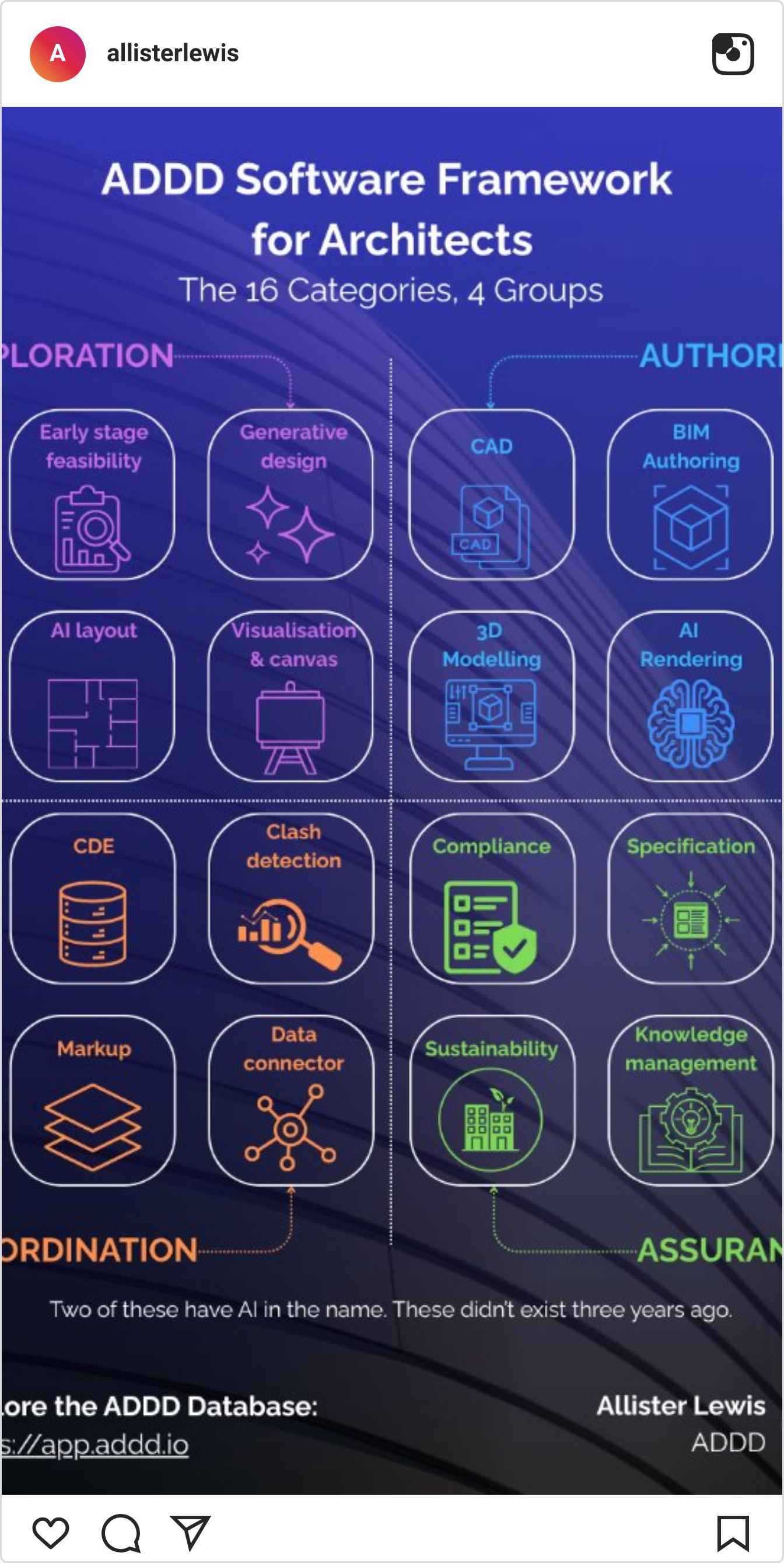
Each week I share new software added to the ADDD Database, plus specific categories, to help you find the right solutions and stay up to date on what's emerging. This week I am doing something different. Rather than five separate tools, here is one assembled workflow, because a list of tools is not a capability until someone decides the order they run in.
Workflow
This workflow is for early stage design and iteration and then using tools to illustrate this quickly and easily with AI rendering and CAD. The sustainability element is key across the design process and therefore will plug in across the iterative process.
Price
Approx. £90.00 /user /month for the stack. (approx. prices correct when published)

Spacio - generative design. Browser-based massing with daylight, sun, wind and noise simulation and live code checks running against the model as you edit, rather than as a separate exercise afterwards. spacio.ai

Plamo - modelling. Illoca's agentic 3D workspace. Sketches, reference images, plans or a written prompt become editable parametric geometry in the browser, with export out to Rhino, Grasshopper or GLB. illoca.com/plamo

xFigura - AI rendering. George Guida's node-based canvas, pulling a large set of generative models into one workspace, with a Speckle connection so you can generate views straight from an existing Rhino, Revit or SketchUp model. xfigura.ai

Rayon - CAD. Browser-based 2D drawing and documentation with real-time multiplayer editing, DWG and PDF import, and template and block libraries. Built for the large amount of practice work that is genuinely 2D. rayon.design

Infrared City - sustainability. AI-surrogate environmental simulation covering wind, thermal comfort, solar and heat stress, returning results in seconds rather than hours, which is what allows it to sit inside the design loop instead of after it. infrared.city

Videos Update
AI-Driven Documentation: Automating Revit Drawing Creation and QA for Architects - where AI can genuinely take over drawing production and QA, and where an architect still needs to check the output. [watch]
One Role Worth Noticing This Week
“Higharc is seeking a Head of Product, Enterprise to lead a major pillar of our Product organization. In this role, you will define the vision, strategy, and execution for the products that help homebuyers explore and configure their homes, while enabling suppliers and builders to move more quickly from selection to estimating and readiness. You will lead product efforts across Estimate and Showroom, shaping connected experiences that improve buyer confidence, operational speed, and business outcomes.”
→ View role: Here
See all roles here: www.aectechjobs.com/search

What this issue means for you
The same argument runs through all three posts this week. Model quality stopped being the constraint some time ago, and the work has moved to everything built around the model: the verification loops, the memory, the handovers, the point at which a person checks the output. That is why the Astra demos look extraordinary and change nothing in an office next Monday. A demo has no verification step, no handover into Revit or Archicad, and nobody carrying professional accountability for what comes out. Tim Fu's pipeline is worth more attention than the demo reels for exactly that reason, because it is several early-stage tools stitched into one sequence rather than one impressive output.
The five-tool stack above is the same point in cheaper form. Spacio, Plamo, xFigura, Rayon and Infrared City each do one thing well, and they only become a capability once someone decides what order they run in and what leaves each one.
The benchmark results are the useful warning here. General-purpose agents are still weak at reading real drawings, converting 2D into 3D and running a calculation a professional would sign. So the job this year is not buying an agent. It is picking one early-stage workflow, mapping it end to end, and deciding where the person sits in it and what they are checking.
There is a commercial edge to this that is easy to avoid. If your fee is still priced on time, then working faster increases your revenue, which means the workflow question and the fee question are the same question and you cannot answer one without the other. If you want to start with someone in the room, the half-day workshop is built for Directors, Digital Leads and BIM Leads and I really enjoy the discussion!
Get in touch - reply to this email or book a call: 30 min with Allister Lewis
That's it for this week.
If something in here landed - or if you disagree - reply and tell me. I read every response.
Thanks for reading!
Allister

No Richard this week - I spotted these folks in a Corvette last week.
