

In partnership with

World’s First Safe AI-Native Browser

AI should work for you, not the other way around. Yet most AI tools still make you do the work first—explaining context, rewriting prompts, and starting over again and again.
Norton Neo is different. It is the world’s first safe AI-native browser, built to understand what you’re doing as you browse, search, and work—so you don’t lose value to endless prompting. You can prompt Neo when you want, but you don’t have to over-explain—Neo already has the context.
Why Neo is different
Context-aware AI that reduces prompting
Privacy and security built into the browser
Configurable memory — you control what’s remembered
As AI gets more powerful, Neo is built to make it useful, trustworthy, and friction-light.
The Shifts Practice Leaders Are Starting to Notice
Hi there,
Across posts, webinars and conversations with practice leaders, one theme kept surfacing: we are not on the edge of incremental change, we are in the middle of structural workflow disruption. AI is accelerating feasibility. Roles are evolving faster than titles. Expectations around speed and clarity are rising. And yet, inside many practices, the project layer holding it all together remains largely improvised.
Below is what sparked the most discussion this week, followed by the deeper theme I believe matters most right now: project and task management as the missing layer in architectural practice.
Let’s get into it.👇
What Sparked the Most Discussion This Week
1. Architects: this is our February 2020 moment for workflows. AI won’t disrupt design first. It will disrupt flow.

Click here to read the full post: LinkedIn.
2. SUPERCHARGING ARCHITECT’S EARLY STAGE FEASIBILITY DESIGNS IN 15 MINUTES

Click here to see the full post: LinkedIn
3. Are you a BIM Manager … or a Digital Design Leader in disguise? Most roles have already shifted - the title just hasn’t.

Click here to see the full post: LinkedIn
Theme of the Week: Project & Task Management: The Missing Layer in Architectural Practice
Across the Technology Blueprint work I’ve delivered last year, from AJ100 practices to mid-sized studios, one pattern keeps repeating: architects do not have a software problem, they have a workflow visibility problem. Most practices are running projects through a mix of email, Excel trackers, shared drives, WhatsApp and fragmented BIM issues. Critical information sits in personal inboxes, programme updates are not consistently reflected in model coordination, and task ownership becomes unclear as projects accelerate.
The result is not chaos, it is friction. Invisible work. Repetition. Late-stage stress.
What we consistently discovered is that project and task management in architecture is rarely designed as a system; it has simply evolved organically.
The Blueprint diagnostics also showed that practices who separate design production from task governance create unnecessary bottlenecks. Revit, Rhino, Archicad and computational workflows may be sophisticated but without a clear project layer defined task ownership, structured milestone tracking, linked issue management and decision logging, the technical stack cannot operate at full leverage.
The opportunity is not adding another app. It is clarifying where tasks live, how they connect to models and deliverables, and how leadership gains real-time oversight without micromanagement. When that layer is structured properly, stress reduces, handovers improve, and teams regain momentum instead of constantly firefighting.
OSOI
I found out about OSOI last year and I have wanted to trial this to see how it assists in the process of managing projects and tasks. So over the next few weeks we will be trialling this as a team and will feedback how we have found this.

This is not a paid promotion, it’s something I am genuinely want to try as it is focussed on AEC and architects and I think it will fill a gap in the market.

We have had an onboarding this week and I will give you a run down in a few weeks time.
If you want to find out more then contact Dejan Jaksic here: [email protected]
Talks this week
Here are some talks coming up or you can rewatch:

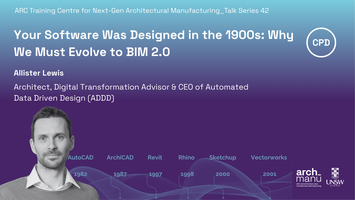
I was invited to be on the Architecture Social webinar last week - catchup here:
5 Generative Design Tools worth exploring!
Here are some Generative Design tools that help for feasibility stage work:
Design buildings faster with less stress with less stress. Design, test, and validate feasibility studies in one environment—with building codes checked as you work.
Best suited for: Architects / Urban Designers / Government / Developers
Fits in workflow: Early Stage Design
Contact: André Agi

Site layouts, in minutes. Design, test and collaborate on feasibility studies and get instant feedback on viability, infrastructure and sustainability metrics.
Best suited for: Architects / Developers / Local Authorities
Fits in workflow: Early Stage Design
Contact: Euan Mills

Get BIM in Minutes. Go from schematic to BIM in minutes - not months - using Revit, ArchiCAD or IFC as inputs. Fast forward your new projects using your own styles, standards, and models
Best suited for: Architects, Computational Designers
Fits in workflow: Early to mid stages
Contact here: Martin Rozmanith

Urban Planning -Faster Than Ever. Visualize critical metrics and feasibility to surpass the competition and ensure decision makers see your proposal. Own every project.
Best suited for: Architects, Government, Developers, Urban Designers
Fits in workflow: early - mid stage design
Contact: Sofia Malmsten

Where architects and AI design together. The generative copilot for better buildings
Best suited for: Architects, Interior Designers, Computational Designers
Fits in workflow: Early - Mid Stage Design
Contact: Pamela Nunez Wallgren

Free Resource: Explore the ConTech Landscape
If you’re scanning this space, I maintain a free ConTech database covering hundreds of tools across architecture, engineering, and construction.
I use it as a starting point before advising practices, not as an answer in itself.
→ Browse the database here: https://contechdatabase.softr.app/

What This Means for Practice Leaders
The consistent signal from the Technology Blueprint work is this: competitive advantage is shifting from individual software expertise to structured workflow governance. Practices that treat project and task management as operational infrastructure, rather than administrative overhead, are reducing rework, shortening feasibility cycles, and improving leadership visibility across live projects. If you cannot see task ownership, decision trails and programme risk in real time, you are managing by assumption.
Tools like OSOI are interesting precisely because they are designed around AEC workflows rather than generic task boards. The question is not whether you need another platform. The question is whether your current project layer is intentionally designed. Over the next few weeks we will trial OSOI internally to assess whether it genuinely strengthens accountability, coordination and reporting across projects. I will share a practical review once we have tested it properly.
At the same time, the generative design landscape continues to accelerate early-stage work. Platforms such as Spacio, Skema, Hektar, Blocktype and Finch are compressing feasibility timelines from weeks to hours. For leadership teams, this creates both opportunity and pressure. Faster concept generation means governance, briefing clarity and task management must keep pace. Without structure, speed simply amplifies fragmentation.
The underlying message is straightforward:
Design capability is no longer the bottleneck. Workflow clarity is.
If you want resilience, better margins and calmer delivery, start by strengthening the project layer before adding complexity elsewhere.
One Role Worth Noticing This Week
Staff Software Engineer, Full Stack - ICHI
We’re looking for a high-ownership, high-accountability Full Stack Senior Software Engineer who isn’t just here to write code but to deeply care about the outcome of what we build. If you think long-term about what makes a product truly great, read on.
Own the full product lifecycle—from brainstorming and technical design to implementation and release.
Navigate trade-offs thoughtfully. You’ll help make these decisions with customer impact in mind.
Collaborate closely with internal customers to deeply understand their needs, ensuring we’re building the right things—not just shipping tasks.
Develop and scale a system that seamlessly integrates multiple LLMs while avoiding dependence on a single model.
Work within a small team to define and execute the technology strategy. In this role, you’ll report to the Head of Engineering.
Engage directly with users, gathering feedback to continuously refine and improve our solutions.
→ View role: Here
See all roles here: www.aectechjobs.com/search

One Next Step
If this issue resonated, let’s have a chat:
→ Book a short diagnostic call - Click here
No pressure, just a next step if useful.
One Question for You
If you asked for a live snapshot of task ownership, programme risk and decision status across all active projects today, could your team produce it within 10 minutes, confidently and without manual collation?
Hit reply, I read every response.
This newsletter exists to help architects navigate technology with confidence, not hype by focusing on workflows, decisions, and real practice constraints.
Thanks for reading!
Allister

